


Weed and Acid Reflux: What the Research Really Shows
You take a puff or eat a gummy, and an hour later your chest burns and acid creeps up your throat. That frustrating pattern is exactly why so many people search for answers about weed and acid reflux, hoping for a straight yes or no. The honest answer is more complicated than that, because cannabis appears to calm some people’s symptoms while making other people’s flare-ups noticeably worse.
This confusion isn’t imagined. Research on cannabis and gastro-oesophageal reflux disease (GORD) remains thin, and much of what exists is borrowed from studies on nausea, gut inflammation, and general digestive motility rather than reflux itself. This article walks through what the evidence actually shows, why the muscle valve between your stomach and oesophagus matters so much, and how your chosen method and cannabinoid ratio change the risk picture.
We’ll also cover practical steps for trying cannabis more carefully if reflux already features in your life, including where BudBuddies fits with lab-tested, clearly labelled products. By the end, you should feel far more confident about where you personally stand.
Key Takeaways
Cannabis can both ease and worsen acid reflux, and the outcome depends heavily on method, dose, and cannabinoid ratio rather than any single universal effect.
THC may relax the lower oesophageal sphincter, while CBD carries a lower theoretical risk to that muscle valve.
Smoked and vaped products tend to carry more digestive risk than sublingual oils or low-fat edibles.
Research specific to GORD is limited, so most guidance comes from broader gut studies rather than reflux-focused trials.
Starting low, choosing CBD-led products, and tracking your symptoms remain the safest ways to explore this area.
What Happens In The Body When Weed Meets Acid Reflux?
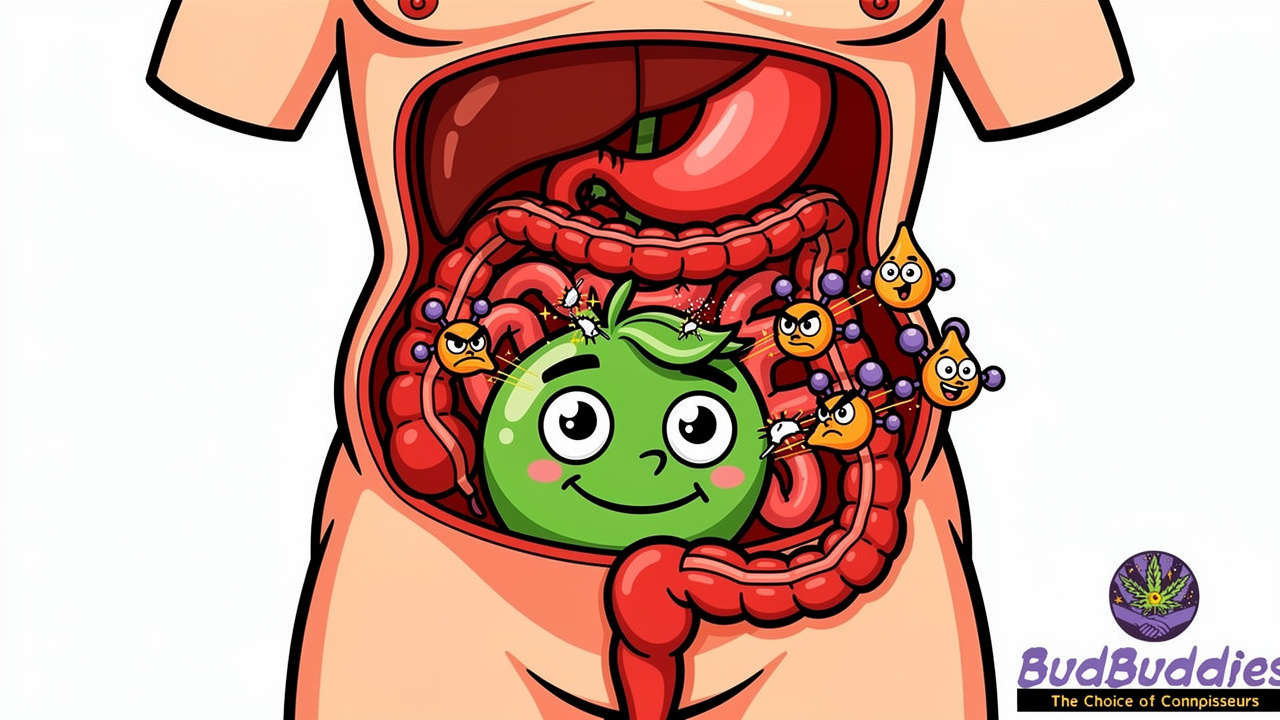
Weed interacts with acid reflux through a muscle ring called the lower oesophageal sphincter, which normally shuts tight to stop stomach acid travelling upward. When this valve weakens or relaxes at the wrong moment, acid escapes into the oesophagus and causes the familiar burning sensation behind your breastbone. Cannabinoids can influence how well that valve does its job, and clinical evidence on cannabis use and GERD risk outlines exactly why cannabis and reflux are so closely linked.
This happens because your gut is packed with cannabinoid receptors, part of what’s called the endocannabinoid system. THC binds strongly to CB1 receptors found throughout the digestive tract, and activating these receptors can affect muscle tone, including the sphincter itself. CBD works more indirectly, nudging these same pathways without the same pronounced muscle-relaxing pull, which is why the two cannabinoids often produce different digestive outcomes.
Can Weed Help With Acid Reflux Symptoms?

Weed may ease certain acid reflux symptoms through anti-inflammatory, pain-relieving, and anti-nausea effects rather than by fixing the underlying valve problem. Both THC and CBD have shown anti-inflammatory properties in various studies, including a systematic review and meta-analysis on herbal treatment for gastroesophageal reflux disease, which could theoretically calm irritation in an oesophagus already inflamed by repeated acid exposure. THC’s well-documented antiemetic effect, the same property used in some medical nausea treatments, may also help anyone whose reflux comes with an upset stomach.
Stress is a well-known reflux trigger, since tension increases stomach acid production and can worsen how the sphincter behaves. CBD-led products in particular are often used for their calming effect, which may reduce flare-ups linked to anxiety rather than diet. None of this amounts to proof that cannabis treats reflux directly, though a detailed look at whether cannabis can reduce acid reflux outlines why the mechanisms are plausible enough to explain why some people genuinely feel better.
Can Weed Make Acid Reflux Worse?

Weed can also make acid reflux considerably worse, and the biggest concern is THC’s tendency to relax the lower oesophageal sphincter, a mechanism explored in a recent study on marijuana use as a lifestyle factor linked to GERD complications. Several studies on smooth muscle tissue suggest THC loosens this valve, which lets stomach acid travel upward more easily than it would otherwise. For someone already prone to reflux, that single mechanism can turn an occasional niggle into a regular, uncomfortable pattern.
Beyond the sphincter, cannabis may slow gastric emptying, meaning food and acid sit in the stomach longer and increase the odds of a backflow. The appetite boost commonly linked to THC, often nicknamed the munchies, can also lead to bigger meals or richer, fattier food choices, both classic reflux triggers in their own right. Smoked cannabis adds another layer of risk, since inhaling smoke irritates the throat directly and coughing fits can physically force acid upward.
Put together, these mechanisms explain why so many people report completely opposite experiences with the same product. Someone using a low-dose CBD oil in the afternoon faces a very different risk profile to someone smoking a strong THC-heavy strain late at night on a full stomach. This is exactly why understanding your own patterns matters more than following generic advice.
Does The Way You Consume Weed Change The Risk?

Yes, how you consume weed changes your acid reflux risk considerably, sometimes as much as the cannabinoid content itself. Smoking is generally viewed as the least favourable option, since inhaled smoke irritates the throat and oesophagus while also triggering coughing that can push acid upward. Vaping avoids combustion but still involves inhalation, so it carries a milder version of the same irritation risk alongside a fast onset that can make THC’s muscle-relaxing effect on the sphincter noticeable quickly. Edibles skip the lungs entirely but are processed through the stomach and liver, meaning cannabinoids interact directly with the digestive tract, and their delayed onset makes overconsumption more likely if you’re not careful with dosing. Sublingual oils, absorbed under the tongue, tend to sit in the middle ground, offering quicker, more controllable effects without any inhalation involved.
Smoking irritates the oesophagus directly and combines two reflux risks at once, inhalation irritation and possible sphincter relaxation, making it the format most likely to aggravate symptoms.
Vaping removes combustion but keeps inhalation in the picture, so throat irritation and coughing remain possible even though the smoke itself is gone.
Edibles avoid the lungs completely but pass through the gut, and their slow, unpredictable onset means people sometimes take more than intended before feeling anything.
Sublingual oils absorb quickly through the mouth’s lining, giving more predictable dosing without inhalation, which many cautious users find easier to manage.
Tip: If you’re new to exploring cannabis with a sensitive gut, start with a format that skips inhalation altogether and gives you a clear, measurable dose from the first try.
BudBuddies’ bioavailability guidance walks customers through exactly these differences, helping anyone with a sensitive gut choose a format that suits how they want cannabinoids to interact with their body rather than guessing.
Does THC-to-CBD Ratio Matter For Reflux?
Yes, the balance between THC and CBD in a product genuinely changes how it affects acid reflux risk. THC is the cannabinoid most strongly tied to sphincter relaxation, so higher-THC products carry a greater theoretical chance of loosening that valve, even though they may also offer stronger pain and nausea relief. CBD does not produce the same pronounced muscle-relaxing effect and is generally viewed as the gentler option for anyone worried about digestive comfort.
Balanced or CBD-dominant products can offer a sensible starting point for people wanting to explore cannabis without leaning straight into high-THC territory. The brand stocks everything from CBD-only oils through to balanced blends and stronger THC options, which means customers can move along that spectrum gradually rather than jumping straight to the strongest thing available. Strain choice adds another layer too, since terpene profiles can shift how relaxing or stimulating a product feels in practice.
How Can You Try Weed Safely If You Have Acid Reflux?

You can try weed more safely with acid reflux by starting with small doses, avoiding inhaled methods where possible, and staying upright for a while after using anything. Lower doses reduce the chance of a pronounced effect on the sphincter or gastric emptying, giving you a clearer read on how your own body responds. Choosing tinctures, capsules, or CBD-led options over smoking cuts out the throat irritation and coughing that make reflux worse, and avoiding cannabis on an empty stomach or right before lying down removes two more common triggers.
A few habits worth building into your routine:
Start small a lower dose gives you a clearer picture of your own response before you consider going any further.
Avoid inhalation where possible, favouring tinctures, capsules, or oils instead.
Stay upright for at least a couple of hours after using cannabis, especially in the evening.
Track your intake noting what you used, how much, and how you felt afterwards makes patterns much easier to spot over time.
BudBuddies’ lab reports and clear per-serving labelling support exactly this kind of tracking, since you always know precisely how much THC or CBD you’re taking rather than estimating. That clarity matters most for anyone managing a sensitive condition like reflux, where small dosing differences can produce noticeably different results.
The Takeaway
Cannabis and acid reflux have a genuinely individual relationship, helpful for some people and unhelpful for others, and no single study settles the argument either way. Method, dose, and cannabinoid ratio all shape which side of that divide you land on, which is why blanket advice rarely fits everyone’s situation.
A cautious, low-and-slow approach, ideally starting with CBD-led or balanced products, remains the sensible route for anyone unsure how their gut will react. BudBuddies’ lab-tested range and straightforward guidance make that gradual approach easier to follow, giving you the information to choose confidently rather than guessing your way through trial and error.
Frequently Asked Questions
Can Vaping Weed Cause Heartburn?
Vaping can contribute to heartburn because it still involves inhalation, which may irritate the throat and trigger coughing that pushes stomach acid upward. Its fast onset also means THC’s relaxing effect on the lower oesophageal sphincter can be felt quickly, so sensitive users may notice symptoms sooner than with slower-acting formats.
Is It Better To Eat Edibles Or Smoke Weed If You Have Acid Reflux?
Edibles are generally the gentler choice, since they avoid the throat and lung irritation that smoking causes. They’re still processed through the stomach and liver though, so choosing low-fat, low-sugar options with clear dosing helps avoid compounding the risk further.
Does Weed Cause Acid Reflux At Night Specifically?
Weed can worsen night-time reflux mainly because sedation encourages lying down soon after use, and horizontal positioning makes it easier for acid to travel upward. Using cannabis earlier in the evening and staying upright afterwards reduces this particular risk considerably.
Can CBD Oil Help Acid Reflux Without The Risks Of THC?
CBD oil carries a lower theoretical risk to the sphincter than THC, since it lacks the same pronounced muscle-relaxing pull, and its anti-inflammatory properties may offer some comfort. Starting with a CBD-only oil remains a sensible, cautious way to explore potential benefits.

