Best Air Purifier for Weed Smell in a Student Room
Weed smell in a small student room hangs around for hours, even when you open a window or spray air freshener. So finding the best air purifier for weed smell in your student room quickly feels important if you care about privacy and comfort.
The truth is that cannabis odour behaves differently from normal cooking smells, and most cheap gadgets barely touch it. That is why so many students end up disappointed after buying the wrong purifier on impulse.
This guide explains what actually causes the smell, how proper HEPA and carbon filtration work, and how to set up a purifier so it actually does something. You will also see why BudBuddies vapes, edibles, and the Elite Pro vaporiser can reduce smell at the source, so you are not relying only on a machine in the corner.
So if you want cleaner air, less stress, and a calmer student room, keep reading.
Why Weed Smell Lingers So Stubbornly In A Student Room

Weed smell lingers so stubbornly in a student room because cannabis terpenes cling to surfaces and keep releasing odour long after a session. These tiny aroma compounds build up fast in a compact space, which is why the room can still smell hours later.
Cannabis produces a rich mix of terpenes, which are volatile organic compounds, or VOCs. Research collected by NCBI notes that cannabis plants contain more than 150 identified terpenes, and many of these are highly aromatic volatile organic compounds — a pattern confirmed by a comprehensive provincial-level VOCs emission inventory study that highlights the scale of sectoral VOC output. They stick to everyday items and fabrics, including:
bedding and soft furnishings
carpets and rugs
hoodies, hair, and other fibres
curtains and even painted walls
From there they slowly drift back into the air.
That is only half the picture. A study summarised by the National Center for Atmospheric Research found that cannabis cultivation in Colorado contributed around 3.5 percent of the region’s VOC emissions. For a single crop to have that kind of share tells you how strong these compounds can be in a small bedroom with limited airflow.
Student rooms are often 10 to 15 square metres, sometimes even smaller in older halls. According to Save the Student, many UK students describe their rooms as “boxy”, which matches that size range. The same compact space that heats quickly also fills quickly with terpenes and smoke particles. Opening a window helps a little, but it mostly dilutes, rather than truly clearing, the odour that has soaked into soft furnishings.
According to the US Environmental Protection Agency (EPA), indoor levels of some pollutants are often two to five times higher than outdoor levels.
So if your room smells skunky the morning after, it is not your imagination. You are dealing with chemistry, not just “stale air”, which is why you need more than a quick spray of fragrance and why proper filtration makes such a difference.
What Actually Makes An Air Purifier Work Against Cannabis Smell

An air purifier only works against cannabis smell when it handles both smoke particles and odour molecules at the same time. The best air purifier for weed smell in your student room uses True HEPA for particles and a serious activated carbon filter for vapours.
True HEPA is the particle side. According to the US EPA, a certified HEPA filter removes at least 99.97 percent of particles that are 0.3 microns across — and statistical signal analysis for optical aerosol spectrometers confirms that accurate particle sizing at this scale is essential to understanding real-world filter performance. Cannabis smoke particles sit within this size range, so a real HEPA filter grabs the visible haze effectively. That clears the air visually and stops fine particles building up in your lungs and over your walls and furniture.
Odour requires a different weapon. Activated carbon works like a sponge made of pure surface area. Odour molecules bump into its tiny pores and stay there. The catch is contact time. A thin sprinkling of carbon in a budget purifier gives each terpene almost no time with the media, so the smell slips through. A thicker, heavier carbon bed forces odorous air to spend longer moving through, so more VOC molecules stick.
Many smoke‑focused purifiers mix carbon with minerals such as zeolite, sometimes treated with compounds like potassium permanganate. Research discussed by Camfil shows that this kind of blended media targets gases such as aldehydes and amines that simple carbon can struggle with — a finding echoed by studies on optimizing indoor air quality: evaluating the synergistic impact of filter integration and botanical solutions. Those gases are a big part of cannabis combustion smell. So if you smoke regularly, a deep carbon or carbon‑plus‑zeolite filter makes a very visible difference.
For students, the practical sweet spot is often a purifier with True HEPA plus at least 300 grams of carbon media for light use. If you smoke daily, moving towards 900 grams or more gives you more headroom before the filter saturates.
What To Look For When Buying

When you start comparing purifiers, a simple checklist stops you wasting money and helps you reach the best air purifier for weed smell for a student room like yours. It keeps you focused on the parts that actually matter for cannabis, not just flashy lighting or an app.
Here is what to focus on when you shop:
True HEPA, Not “HEPA Style”
True HEPA wording on the spec sheet is key, not “HEPA style” or “HEPA type”. Those softer phrases usually mean a cheaper filter that misses a lot more smoke. Look for a clear particle removal claim of 99.97 percent at 0.3 microns, which is the standard quoted by the US EPA.Real Carbon Filter Weight
Carbon filter weight should be clearly stated, because this separates serious odour control from decoration. Aim for at least 300 grams if you only smoke occasionally, and 900 grams or more if you use cannabis several nights a week. A heavier filter lasts longer and keeps smell under control between changes.CADR Matched To Room Size
CADR, which stands for Clean Air Delivery Rate, needs to suit your room size. For a typical UK student room, a smoke CADR of 150 to 200 cubic metres per hour is a good target, which mirrors guidance from the Association of Home Appliance Manufacturers. That figure means the machine can cycle your room air several times each hour.Noise Level You Can Sleep With
Noise level matters if the purifier is running while you sleep or study. Try to find a model that stays under about 45 decibels on its medium setting, which is similar to a quiet library. Check that there is a “sleep” or night mode for softer fan noise while you rest.Compact, Portable Design
Compact, portable design is very handy in halls and shared houses. A tabletop or slim floor unit is easy to squeeze between a desk and a bed, and easy to pack when you move at the end of term. You do not need wall installation or anything permanent.Filter Replacement Costs
Filter replacement costs add up over the year, so read those prices before you choose. As a rough guide, HEPA filters often last 9 to 12 months, while cannabis‑facing carbon filters work best when changed every 3 to 6 months.
How To Get The Most Out Of Your Air Purifier In A Student Room
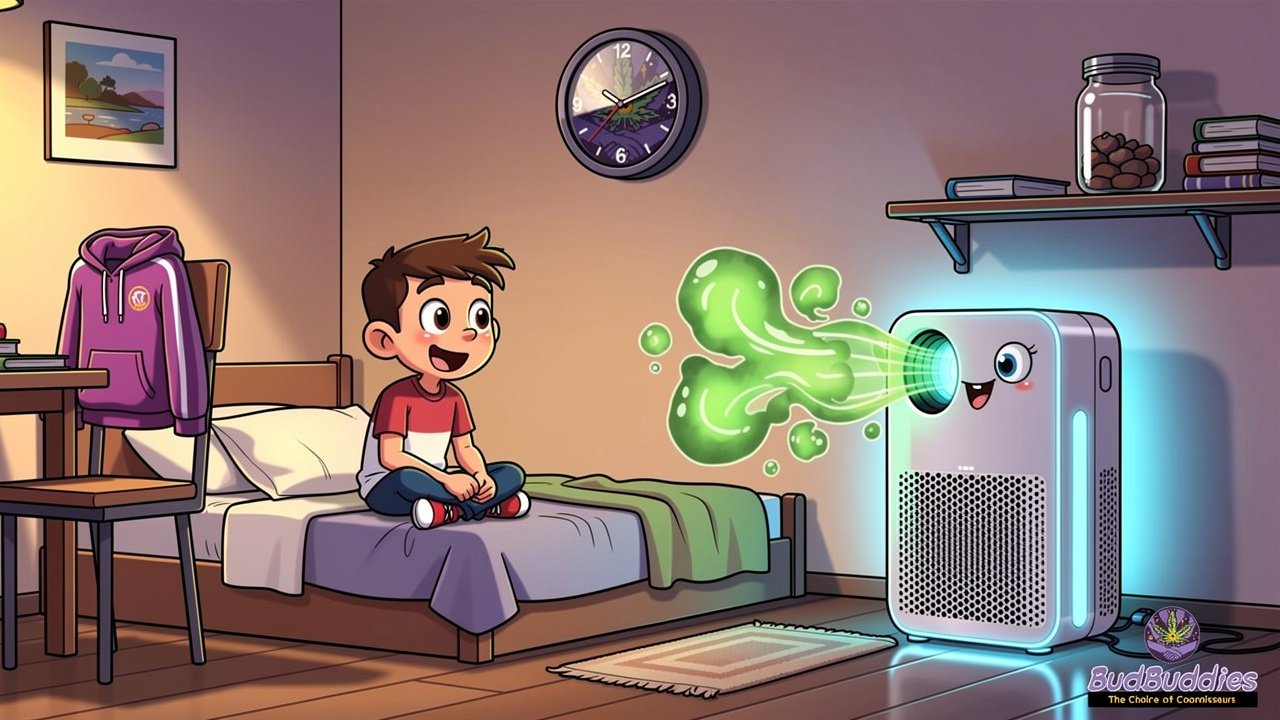
You get the most out of your air purifier in a student room by placing it near where you smoke, running it before, during, and after a session, and keeping windows closed while it works. Used this way, a well‑chosen unit is far closer to the best air purifier for weed smell in your student room than the same device stuck in the wrong corner.
Placement is the first big factor. Air purifiers work by pulling air through their filters, so the cleaner needs to sit in a stream of air, not as a distant box. Putting your purifier within about one to two metres of where you exhale gives it first shot at the thickest smoke, which keeps the rest of the room fresher. Try to keep a little space around the intake and outlet so the fan can move air freely.
Timing comes next. If you only switch the purifier on once the smell is strong, you are asking it to fix air that has already soaked into cushions, curtains, and clothes. For better results, start the fan ten to fifteen minutes before you light up, keep it running the whole time, and leave it on for an hour or two afterwards. Research on indoor air cleaners from AHAM shows that steady running achieves better real air changes per hour than short bursts.
Ventilation can seem confusing, so here is a simple rule. While the purifier runs on a higher speed, keep doors and windows mostly shut, so the same air passes through the filters again and again. Once you have finished, you can briefly open a window on vent setting with the purifier still running to clear any leftover stuffiness.
To help your purifier further, layer a few simple habits:
Use a sploof or DIY exhale tube filled with activated carbon to cut the amount of smoke that reaches the room in the first place. This means less work for the purifier and less odour landing on soft furnishings, especially in tiny halls bedrooms.
Store your cannabis in airtight glass jars or proper smell‑proof bags instead of open tubs or baggies. Constant slow leakage from storage can make your room smell even on nights when you are not using, so a sealed container keeps your “baseline” fresher.
Wash bedding, hoodies, and curtains regularly, and wipe hard surfaces with a mild cleaner — since research on integrating multivariate analysis and Air Pollution Tolerance Index approaches confirms that consistent removal of surface-trapped VOCs meaningfully reduces indoor odour levels. Terpenes cling strongly to fibres, so laundering breaks that film. According to the European Environment Agency, indoor VOC levels rise when fabrics and dust are not cleaned over time, which fits with what many students notice — and an algae-based air purifier: tackling CO2, PM2.5, and TVOCs study further illustrates just how quickly total VOC loads can build indoors without active removal strategies.
Replace carbon filters on schedule, even if the purifier light has not yet changed. Once carbon is saturated, it not only stops helping, it can start slowly releasing trapped odours back into the air. Mark a reminder in your phone so you do not forget.
Tip from BudBuddies: Run your purifier on a low setting whenever you are hanging out in your room, then switch to a higher speed just before and during a session for much better odour control.
A Smarter Alternative: Cutting Odour At The Source With BudBuddies

The smartest way to deal with weed smell in a student room is to cut odour at the source with low‑smell formats from BudBuddies. When you do that, your purifier has far less work to do, and sometimes you barely need one at all.
Traditional smoking produces thick smoke with a terpene‑heavy scent that can hang in the air for two to four hours. Vaping is very different. Research from Public Health England on vapour products shows that vapour contains far fewer by-products than smoke, which also means less smell — and characterization of respiratory particles released during continuous speech and its relation to mask performance further confirms how particle composition and volume differ dramatically between vapour and combustion emissions. In practice, most cannabis vapers notice that light scent from a THC vape fades within about fifteen to thirty minutes in a small room.
BudBuddies leans into that with a curated range of THC vapes and cartridges focused on flavour, consistency, and smooth vapour. Instead of a cloud that clings to curtains, you get a faint, short‑lived aroma that a modest purifier can handle with ease. For many students, that change alone takes them much closer to the best air purifier for weed smell student room setup, because the “smell problem” has shrunk at the source.
Then there are edibles. BudBuddies edibles give you the effects you want with zero room odour at any point. Nothing to burn, no vapour to clear, no lingering terpenes in the air. If you live in tight halls or share a thin‑walled terrace, this is the quietest way to relax without your bedroom announcing it.
For those who enjoy flower, the BudBuddies Elite Pro portable vaporiser bridges the gap. Its hybrid heating system and precise digital temperature control warm your herb at sub‑combustion levels, rather than setting it alight. That lower temperature means far fewer VOCs and a much softer scent compared with a joint. Paired with a sensibly sized HEPA‑plus‑carbon purifier, it is a strong setup for privacy‑minded students.
BudBuddies also tries to keep this approach friendly on a student budget. You can stack first‑time buyer discounts with the BudCash rewards programme, and orders over £50 qualify for free shipping. Every parcel arrives in plain, odour‑proof packaging, so even your post stays discreet. For many readers, switching format with BudBuddies turns a constant smell battle into a simple, low‑stress routine.
Wrapping Up
Managing weed smell in a student room really comes down to two smart moves. First, choose and use your purifier properly, with True HEPA for smoke particles and a thick activated carbon filter for VOCs, sized to your room and placed close to where you use cannabis. Run it before, during, and after sessions, and keep on top of filter changes.
Second, reduce odour at the source so there is less for any machine to handle. BudBuddies THC vapes, edibles, and the Elite Pro vaporiser all give you smoother experiences with far less or even zero room smell. Every product batch is independently lab tested and shipped in discreet, well‑presented packaging, so the whole experience feels calm and organised.
If you want the best air purifier for weed smell in your student room to actually feel effective, pair it with smarter formats from BudBuddies at BudBuddies.cc and enjoy a fresher space with far less effort.
Frequently Asked Questions
Question: Does an air purifier actually get rid of weed smell?
Yes, an air purifier can reduce weed smell when it combines True HEPA and a substantial activated carbon filter. HEPA takes care of smoke particles, while carbon traps the terpenes and VOCs that cause odour. Thin carbon pads in budget units saturate quickly and tend to offer only mild improvement. Choosing enough carbon media and running the unit correctly matters just as much as the brand.
Question: How long does weed smell last in a student room?
Weed smoked in a joint or pipe can leave noticeable smell in the air for two to four hours, and on fabrics for much longer. Vaping tends to linger for thirty to sixty minutes, while THC vapes often fade within fifteen to thirty minutes. Terpenes continue to off‑gas from soft furnishings, which is why running your purifier after a session helps.
Question: Where should I put my air purifier in my room?
Place your air purifier within about one to two metres of where you usually exhale smoke or vapour. That position lets the intake grab the densest air before it spreads around the room. For general air quality, a central spot with clear space on all sides works well. Avoid pushing the unit into corners, under desks, or behind furniture, as that restricts airflow.
Question: Can I use an air purifier in student halls?
Yes, you can use an air purifier in student halls, because portable units simply plug into a normal socket. Compact tabletop models suit the tight floor space and low ceilings that many halls bedrooms have. There is no need for drilling or permanent changes, and you can pack the unit with you when you move at the end of term.
Question: What is the best way to hide the smell of weed in a student room without an air purifier?
The best way to hide weed smell without a purifier is to cut odour at the source by changing format. BudBuddies THC vapes produce minimal, short‑lived scent, and BudBuddies edibles create no room odour at all. Airtight storage for your stash, regular laundry, and quick window breaks after use add extra privacy in shared accommodation.